How gradient descent finds features in wide networks
How does stochastic gradient descent (SGD) learn internal representations in a wide neural network trained on a rich target function? We study this in two-layer networks that learn a target given by a network of the same architecture, with an arbitrary nonlinearity, when the width k and the input dimension d grow proportionally.
Too many order parameters
Since the work of Saad and Solla in the 1990s, the standard way to describe SGD in two-layer networks is to follow a few macroscopic order parameters, the overlaps between the weights of the student network and those of the teacher. For narrow networks there are only a handful of them, and they obey closed equations. At extensive width there are of order k² overlaps, and no obvious way to reduce them to a few. The two classical alternatives do not help here: the lazy (neural tangent kernel) limit does not learn features, and the mean-field limit describes the neurons by a distribution that lives in a space whose dimension grows with d.
A mesoscopic description
Instead of tracking every overlap, we track their distribution. Expanding the activation function in Hermite polynomials organizes the order parameters into a hierarchy, one level per Hermite mode of the target. Learning then goes through four stages.
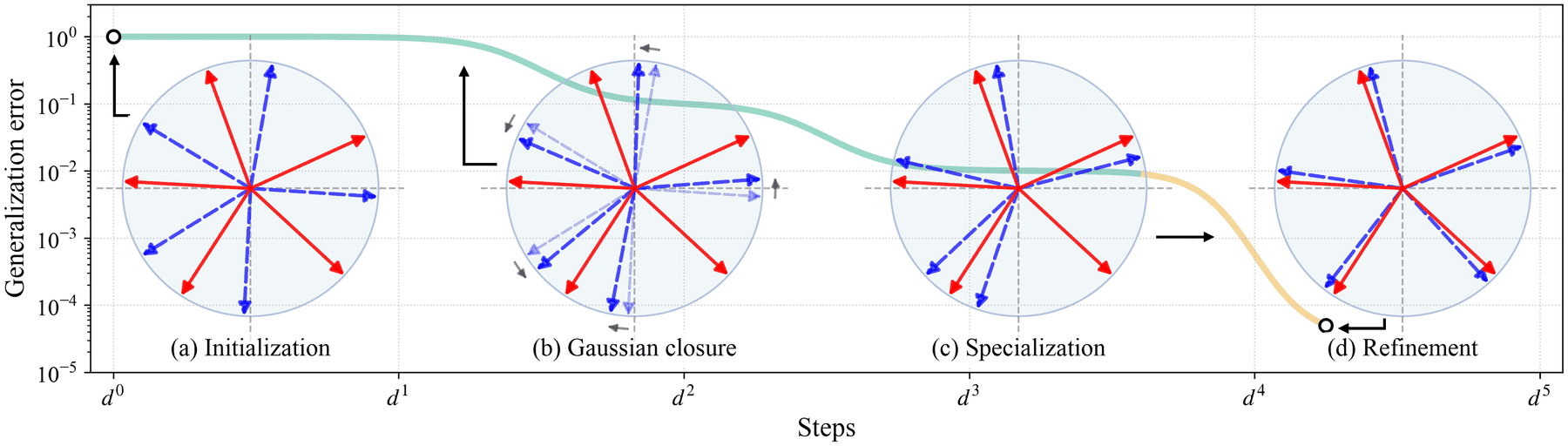
- Gaussian closure. Early on, the student learns only the linear and quadratic components of the target: it recovers the teacher’s weights up to a rotation, while every individual teacher–student overlap stays small, of order d−1/2. Treating these overlaps as jointly Gaussian closes the dynamics on a few collective variables, whose equations predict the test loss over this whole stage.
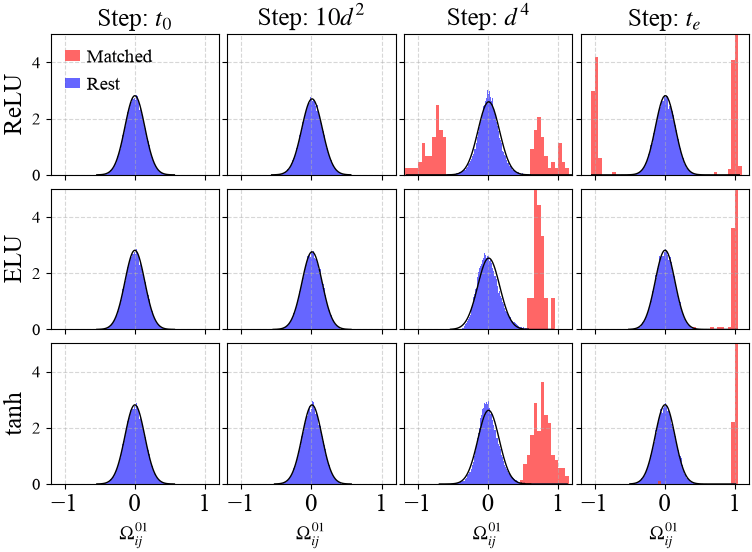
- Specialization. Gaussian closure then breaks down: a finite fraction of student neurons become strongly correlated with individual teacher neurons, and the overlap distribution splits into a Gaussian bulk and outliers. We estimate when this happens: the time scales as kr/(log k)r−2, where r is the lowest Hermite degree above two present in the activation. Specialization is sped up, by a constant factor that depends on the activation, through quadratic shielding: having learned the linear and quadratic components of the target filters out gradient fluctuations.
- Refinement. Once each student neuron is matched to a teacher neuron, we derive the dynamics of the matched overlaps and their fixed points.
The activation function shapes how specialization looks. With ReLU, some student neurons align with a teacher neuron and others anti-align with it; with ELU or tanh all matches are positive.
Why it matters
Collective learning comes first and gives way to the discovery of individual features, and the paper says when a simple statistical description of learning holds. It complements our Bayes-optimal theory of feature learning, which describes the same specialization from the point of view of the best achievable performance rather than of training.