Il Piccolo, September 13, 2026
Giulia Basso’s article on our Physical Review X paper on feature learning, with a summary in English.
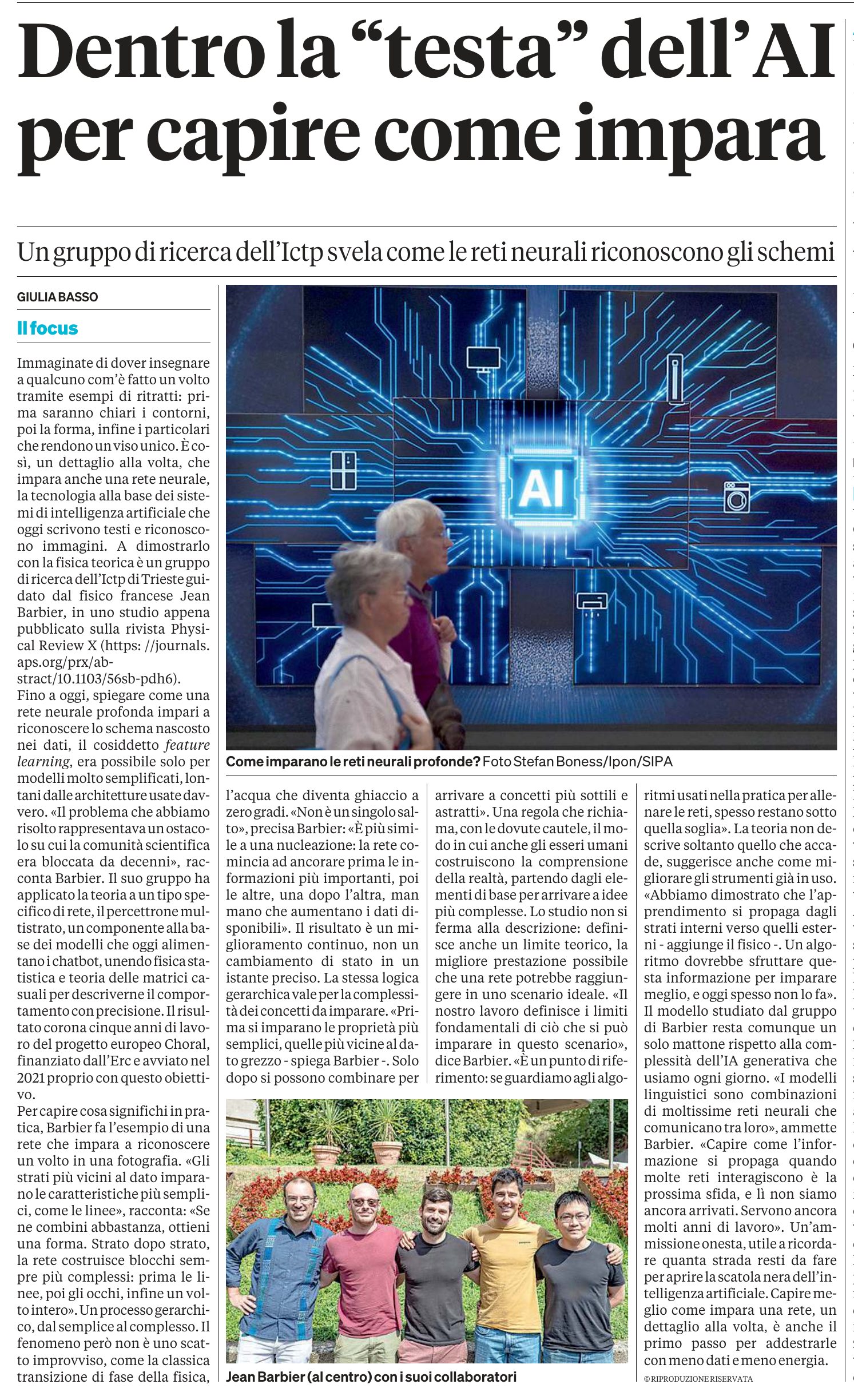
In English
Trieste’s daily newspaper reports on our Physical Review X paper. The headline reads “Inside the ‘head’ of AI to understand how it learns”.
The article opens with an analogy: learning what a face looks like from portraits, first the contours, then the shape, and finally the details that make a face unique. Neural networks learn in the same way, one detail at a time, and the group showed it with the tools of theoretical physics.
Until now, how a deep network learns the hidden structure in its data, known as feature learning, could be explained only in very simplified models. The group studied the multilayer perceptron, a building block of today’s models, by combining statistical physics and random matrix theory. The result crowns five years of the ERC project CHORAL, started in 2021 precisely with this goal.
The layers closest to the data learn the simplest features, such as lines; deeper layers combine them into shapes and then whole faces. This does not happen as a sudden jump, like water freezing at zero degrees, but more like nucleation: the network first anchors the most important information, then the rest, as more data become available.
The work also sets the best performance a network could reach in an ideal setting. Algorithms used in practice often stay below it, and the theory suggests how to improve them, since learning propagates from the inner layers to the outer ones.
The article ends with what remains open: language models combine many interacting networks, and understanding how information flows between them is the next challenge, one step towards training networks with less data and less energy.